T-SQL
001. History of SQL to Modern T-SQL
What is SQL?
SQL (Structured Query Language) is a domain specific language used to manage data, especially in a relational database management system (RDBMS).
Why We Need SQL?
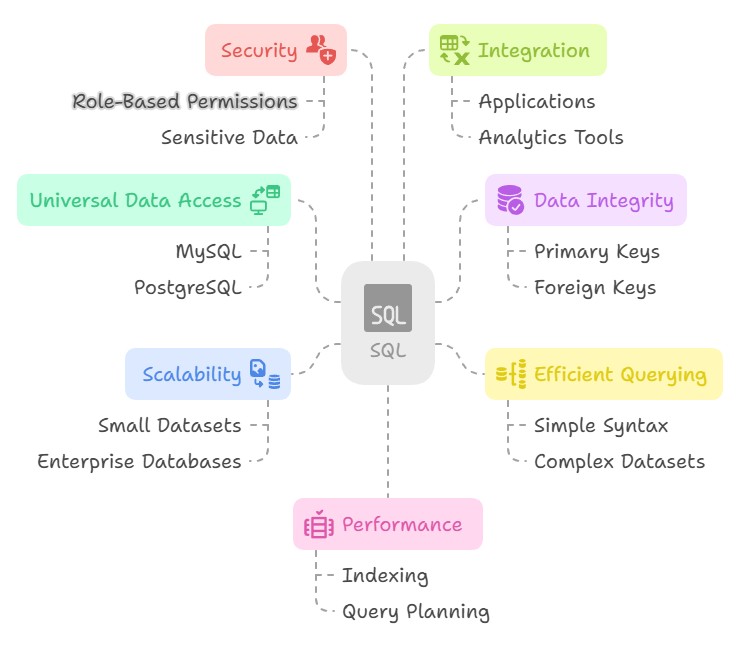
SQL is essential because it provides:
- Universal Data Access – Standardized across major database systems (MySQL, PostgreSQL, SQL Server, Oracle)
- Data Integrity – Enforces constraints (e.g., primary keys, foreign keys) to maintain accuracy
- Efficient Querying – Retrieves complex datasets with simple, readable syntax
- Scalability – Handles small datasets to massive enterprise databases
- Security – Role-based permissions protect sensitive data
- Integration – Works with applications, analytics tools, and cloud services
- Performance – Optimized execution through indexing and query planning
Key Developments
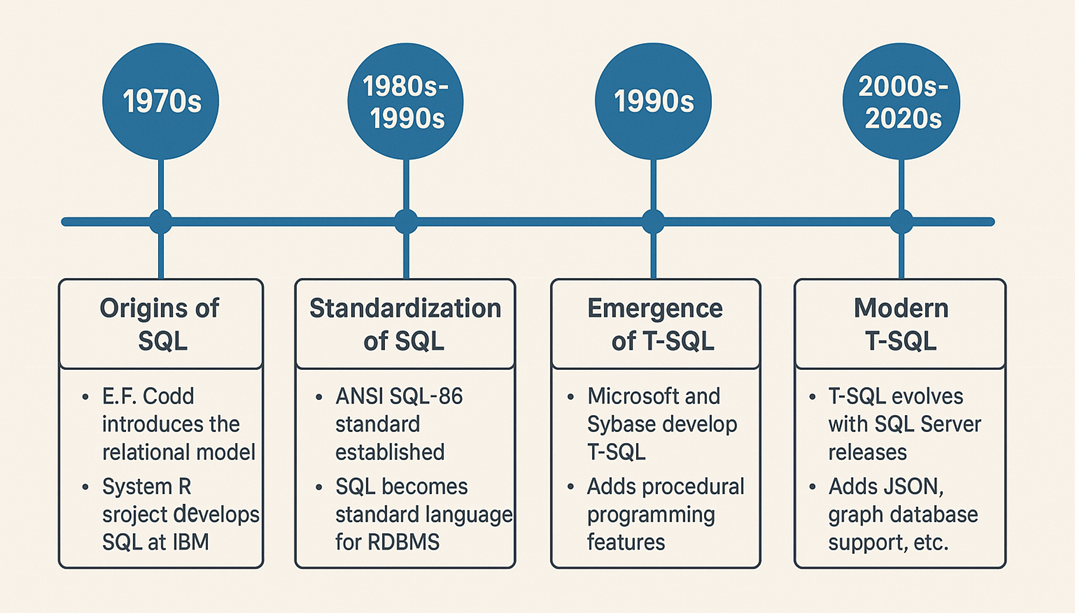
1970s: Origins of SQL

- E.F. Codd introduces the relational model (1970)
- IBM’s System R project develops SEQUEL (later SQL)
1980s–1990s: Standardization & Commercialization
- ANSI SQL-86 – First SQL standard
- Commercial databases adopt SQL (Oracle, DB2, SQL Server)
1990s: T-SQL Extensions
Microsoft & Sybase enhance SQL with:
- Control flow (
IF...ELSE,WHILE,BEGIN...END) - Variables & error handling (
TRY...CATCH) - Stored procedures, triggers, functions
2000s–2020s: Modern SQL
- JSON/XML support for semi-structured data
- Graph database capabilities
- Temporal tables for historical tracking
- Machine Learning integration (e.g., SQL Server ML Services)